From the First IVF Breakthroughs to AI: What Fertility Leaders Say Comes Next
By Andrea Syrtash, Editor-in-Chief at pregnantish
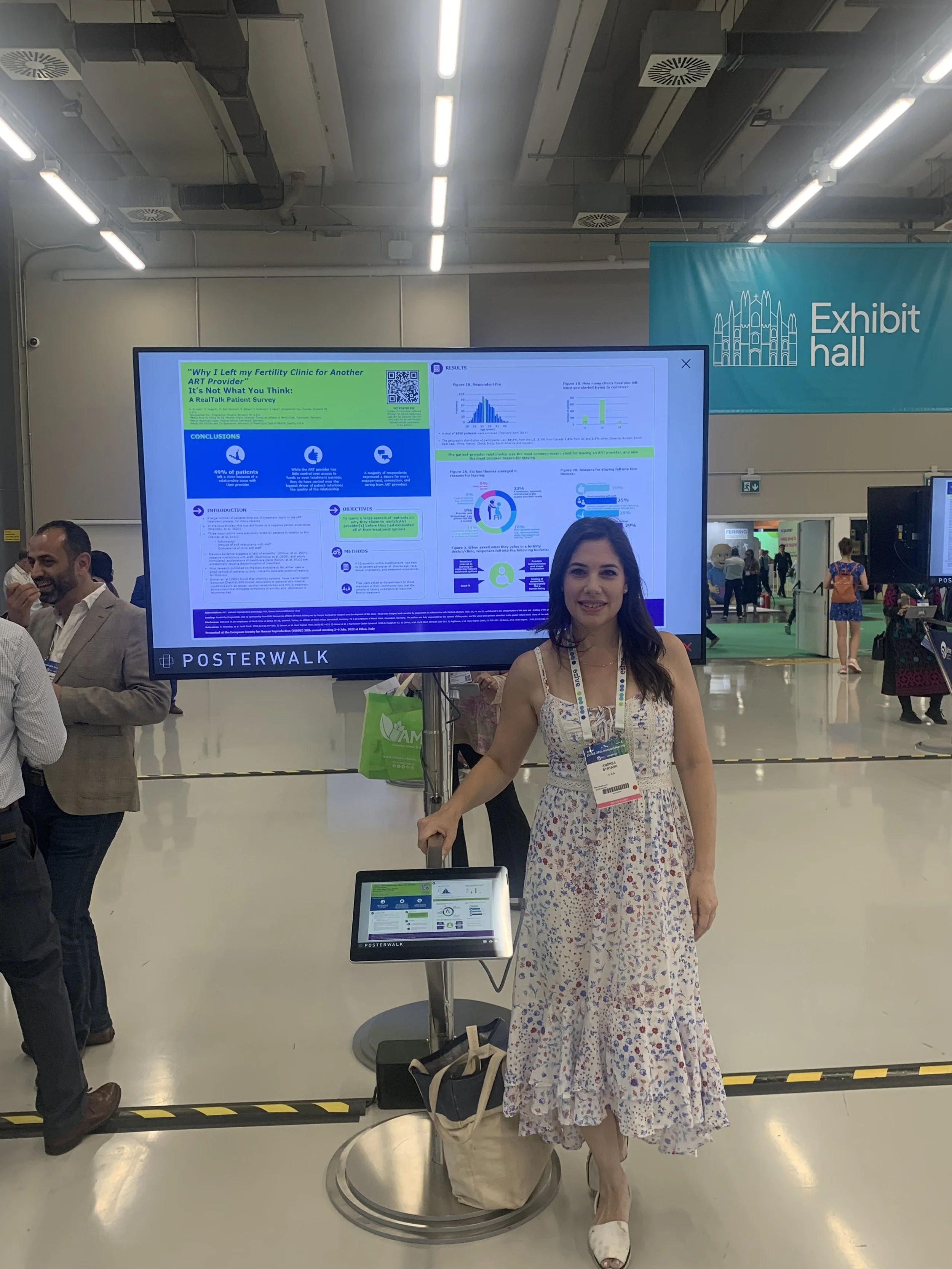

Forty-eight years ago, the birth of Louise Brown, the world's first IVF baby, made international headlines and changed reproductive medicine forever. Louise recently celebrated her 48th birthday, and this year, walking the ESHRE (European Society of Human Reproduction and Embryology) floor as accredited press, we were awe-struck by how much has developed in the years since her birth.
One question I had as I saw all the new companies and legacy organizations on the ESHRE floor was: What will IVF look like ten years from now?
Two letters especially stood out: AI.
Artificial intelligence was everywhere, alongside robotics, advanced imaging technologies, new approaches to sperm selection and increasingly sophisticated ways to understand eggs and embryos. Through pregnantish and the World Fertility Awards, we honored some of this incredible innovation.
Read our World Fertility Awards coverage on the future of AI-enabled fertility labs
One of the benefits of attending ESHRE as press is getting to move between generations and corners of the fertility field: from scientists who helped build modern IVF, to healthcare leaders operating clinics across continents, to companies investing in what comes next.
And those conversations revealed something more interesting than a single “next big thing.”
The future of fertility may be defined by the tension between innovation and humanity: how much more technology can tell us, and how carefully the field uses that information to actually improve people's care.
That tension is something that we, at pregnantish, have thought about for years.
In 2022, we presented our large-scale patient-retention research at ESHRE, drawing on more than 1,000 fertility patients from around the world. The research was subsequently published in Human Reproduction. Our survey of 1,233 patients found that dissatisfaction with fertility clinics was often tied not simply to clinical issues, but to a lack of empathy, support and involvement in treatment decisions.
Over almost a decade of building a global community of people who have traveled this journey, we've learned that patients don't experience fertility care as a clinical outcome alone. They experience it as a relationship, a journey and an often overwhelming, complicated and confusing system that they have to navigate.
Professor David Gardner, Who Changed IVF, On the Mission Behind the Science
Professor David Gardner has spent decades immersed in the science of human reproduction. His work helped pioneer blastocyst culture and transfer, and contributed to the shift toward more effective single-embryo transfer. His embryo grading system also became widely used internationally as a way of describing blastocyst morphology. His research has helped shape modern IVF laboratory practice.
But when I asked him how he describes what he actually does, he didn't lead with his impressive academic title.
“I am first and foremost a scientist who works in human IVF,” he said, “and I simply say to myself, my job title is to help people have families as soon as possible.”
That focus was shaped early in his career.
Professor Gardner remembers one of his first clinical cases, around 1990. Before an egg retrieval, a patient who was crying grabbed his arm, “Please, please get me pregnant,” she told him.
Gardner remembers the encounter as a lightning bolt. “This is so real,” he recalled thinking. “I have to do everything I can to help patients such as her.”
And her words have guided his work in the fertility field for decades since.
When IVF Meant Transferring Four Embryos
Today's fertility patient encounters a treatment landscape shaped by decades of advances that can be easy to take for granted. Gardner remembers something very different.
In the 1990s, pregnancy rates were lower and clinics routinely transferred multiple embryos in an effort to increase the chance that one would implant.
In 1995, Gardner recalled, the average number of embryos transferred in the United States was four.
“You have to take a minute to think about that,” he said.
Particularly in the United States, where patients were often paying substantially out of pocket, people were willing to take the chance. But successful treatment could also mean twins or triplets.
“So the irony was back in the ‘90s that infertility contributed most to multiple births,” Gardner said.
Gardner's work would help change that equation. He and his collaborators developed approaches that allowed embryos to be cultured to the blastocyst stage, giving embryologists more information before transfer. His work helped drive the move toward blastocyst transfer and ultimately toward single-embryo transfer, reducing the risks associated with multiple pregnancies.
That work also led to something nearly every IVF patient now recognizes: the Gardner Method of Embryo Grading.
Why Is Your Embryo Called a 4AA?
If you've gone through IVF, you've probably encountered (sometimes confusing) letter and number combinations like 4AA, 5AB or 3BB.
Gardner's story of how those grades came to exist is surprisingly practical.
He would walk into the lab in the morning, look at developing blastocysts and declare: “This is beautiful, this is gorgeous.”
His colleagues essentially told him that wasn't precise enough.
“That's not going to help us much,” he remembers. “We can't fit it on the patient notes. We need a grading system.”
So he created one.
The system describes the blastocyst's expansion and the appearance of its two major cell types, the inner cell mass and the trophectoderm.
Gardner assumed it would be temporary. “I said to the lab, this will last six months, 12 months tops.”
More than two decades later, the grading system has become an international language for describing blastocyst morphology, widely used in clinical embryology called “The Gardner Method”.
Yet Gardner is also careful about what those grades cannot tell patients. A higher morphology grade can be associated with a lower chance of aneuploidy, a condition in which a cell has an abnormal number of chromosomes. But, as he emphasized: “It's not absolute, it's not absolute.”
That gap between what the human eye can observe and what patients actually want to know is one reason AI has generated so much interest.
AI at ESHRE Was Everywhere. But Should It Make the Decision?
On the ESHRE floor this year, AI was impossible to miss.
I was curious: is it mostly hype, or will artificial intelligence radically improve outcomes? Or perhaps something in between?
I asked Prof. Gardner which technologies genuinely excite him, and where he believes the field should proceed cautiously.
His first concern was robotics.
“The willingness to sacrifice years of experience and knowledge for the robot... concerns me,” he said.
He underscored that this doesn't mean he opposes automation. For him, the distinction is how it is used.
“This is going to augment what we do, not replace us,” Gardner said.
And on AI, he was even clearer:
“We use AI to augment our decision, not to make our decision.”
“The combination” of artificial intelligence and human intelligence, he added, “is very powerful.”
That distinction shared by Prof Gardner, technology as an assistant rather than an authority, may be one of the most important themes for the next generation of fertility care.
Can AI Tell Us More About an Egg?
One frontier particularly interests Gardner: understanding egg quality.
Embryologists have increasingly sophisticated ways to assess embryos. But patients freezing unfertilized eggs face an enormous unknown.
The eggs may look “normal,” but what does that actually tell us?
It's one reason AI-based egg assessment and technologies such as MAGENTA™ by Future Fertility, designed to provide patients with additional information about their frozen eggs, are attracting attention.
The goal shouldn't be to promise certainty where certainty doesn't exist. Rather, it is to add another useful layer of information to decisions that historically relied heavily on age, egg count and visual assessment.
That question connects to a broader point that came up repeatedly in conversations at ESHRE: reproductive medicine cannot continue looking at isolated parts of the fertility equation.
As many at ESHRE shared with me, and with what we've believed for years: we need to have a holistic view of everything – and that includes sperm. After all, you cannot make a baby without a healthy egg, healthy sperm and a healthy uterine environment.
Why Is the Woman Still Carrying So Much of the Treatment Burden?
Male fertility has been “neglected for years,” leaders at ESHRE reinforced.
At a fertility industry symposium presented by Gedeon Richter, the discussion centered on a provocative question: “Why do we treat women when the issues lie with the men?”
In cases of male-factor infertility, women can end up carrying much of the physical and psychological burden of treatment.
That’s beginning to change. Now, scientists are looking more closely at sperm DNA fragmentation, paternal age and new methods of sperm selection that attempt to mimic the physiological environment sperm encounter within the female reproductive tract.
That represents an important change in philosophy. Instead of asking only how to manipulate reproductive cells more effectively, scientists are increasingly asking what biology itself can teach us about handling them better.
Technology Can Scale, But Care Still Has to Feel Human
Jane Exon, Vice President and Head of Patient Experience at FutureLife, sees enormous potential in technology, including AI tools that can assist doctors and embryologists. But when we spoke at ESHRE, she pointed to something much more basic as a differentiator.
“The treatment is the treatment. IVF is IVF,” she said. “So what's the differentiator? It's the patient experience.”
That perspective immediately brought me back to research we conducted at pregnantish on why fertility patients stay with—or leave—their clinics.
In our global study, surveying patients across 21 countries about their clinic experience and treatment decisions, we learned that nearly half of the 1,233 respondents who had left a fertility clinic cited problems with the patient-provider relationship, including not feeling heard, poor communication or bedside manner, a lack of personalized care, or simply feeling “like a number.”
What struck us then, and what continues to come up in our conversations with our audience, is that some of the strongest drivers of retention aren't technological at all. Patients told us that connection with clinic staff mattered. So did feeling that their treatment was tailored to them, having their options explored, and being treated with compassion.
This is especially important in a field that is moving so quickly toward AI, automation and increasingly sophisticated laboratory tools.
There is no doubt that clinical innovation can make fertility care better. But even the most advanced technology exists inside a relationship between a patient and the people caring for them.
Our research reinforced something that sounds obvious but is easy to lose in a complex healthcare system: patients remember how they were treated.
They remember whether somebody listened, whether they were offered options, whether communication broke down, and whether they felt like a human being or a number.
Exon described the goal inside a clinic simply: “Remove pain, remove the friction, and introduce love,” which she calls “love moments.”
I started my career helping people navigate love and relationships, and I often share with our audience that trying to make a baby “with help” is, at its core, one of the greatest acts of love. We're doing it in the hopes of loving a baby.
As fertility medicine becomes more sophisticated, that human side of care shouldn't be treated as secondary to innovation. In some ways, it may matter more than ever.
The Second Wave of IVF
Prof. Gardner describes the evolution of IVF in waves.
The first was fundamentally biological: physicians, scientists and embryologists figuring out how to stimulate an ovary, retrieve an egg, fertilize it, grow an embryo and create a pregnancy.
The second is increasingly technological: AI, advanced imaging, engineering, new microscopic devices and more precise ways of observing eggs, sperm and embryos without disrupting them.
The IVF laboratory of the future may increasingly sit at the intersection of reproductive biology, engineering, chemistry, data science and advanced imaging.
But as that happens, the industry has to resist confusing technological sophistication with meaningful progress.
The question isn't simply whether AI can analyze an embryo faster. It's whether the information it provides helps a patient make a better decision.
The question is whether technology can reduce uncertainty without creating false certainty, and whether automation frees clinicians to actually spend more time with patients rather than less.
Finally, we should ask whether large global fertility organizations can use technology to improve consistency without losing the local and important human experience of care.
New Doesn't Automatically Mean Better
Professor Dr. Anis Feki, Chair of the European Society of Human Reproduction and Embryology, offered perhaps the clearest test for the next generation of fertility innovation.
I was lucky to have time with him at ESHRE to explore not only where reproductive medicine is going, but what he believes needs to change in the way patients experience care along the way.
For Feki, one of the biggest shifts ahead isn't simply technological. It's a move away from what he described as a “procedure-centered model” toward one that is genuinely patient-centered.
That means resisting the instinct to equate progress with simply offering more treatment.
In some clinics, he told me, patients can still encounter an “IVF, IVF, IVF” approach without enough input from surgeons, psychologists, embryologists, geneticists or other specialists who may see a different piece of the puzzle.
Instead, he said, patients need “clear information on evidence, uncertainty, costs, and alternatives, not simply access to more tests or treatment.”
That distinction feels especially important at a meeting like ESHRE, where every turn on the conference floor seems to reveal another emerging technology, test or potential add-on.
Innovation can be enormously exciting. But more doesn't automatically mean better.
Dr Feki repeatedly brought the conversation back to the organization and quality of the care surrounding the science.
“The greatest opportunity is in the organization of care,” he said, emphasizing the importance of timely referrals and “continuity with a trusted team” because patients need “to trust and feel at ease.”
He also challenged one of the most common ways fertility success is discussed.
“You should not measure only the pregnancy rate,” Feki said.
He pointed instead to cumulative outcomes, safety, treatment discontinuation and patient experience as meaningful parts of the equation.
And when our conversation turned directly to the future of innovation, he offered a standard that stayed with me.
His hope is that “innovation is assessed by meaningful benefit for patients,” rather than by “novelty alone.”
At pregnantish, we know well that this may be one of the most important questions facing the industry.
Not simply: Can we build it?
But: Does it make treatment safer, clearer, more effective or more accessible for patients?
Gardner's own career is a reminder of what meaningful innovation can look like.
A grading system created because “beautiful” wasn't precise enough became an international language for embryologists. Better blastocyst culture helped make safer single-embryo transfer possible.
Today's experimental AI model, imaging platform or microscopic device may eventually become equally ordinary.
We don't yet know which innovations will endure. But after talking to leaders across the ESHRE floor, one thing to me felt clear: the future of fertility medicine isn't a contest between people and technology.
The more interesting future is one where science, technology and human judgment get better together, and where patients actually feel the difference – not only in better clinical outcomes, but in the process of feeling more seen, heard and valued.
Because ultimately, that is the secret sauce to any relationship.